
Well pumps rarely have instantaneous failures. Normally, small problems build up over months or even years before the system has a noticeable malfunction. Due to detection difficulty, improperly sized well pumps have historically been one of those unnoticeable problems that can significantly reduce the pump life.
This doesn’t have to be the case with a real time well monitoring system. Now, changing pump performance can instantly be spotted and addressed to maintain system longevity.
How Can This Happen in the First Place?
Well, let’s review how pumps are sized. In general, pumps are selected to meet two requirements: the maximum household flow rate and total lift.
The maximum flow rate is a function of household fixtures, bathrooms, and irrigation requirements and is measured in gallons per minute (GPM). The lift, measured in feet (ft), is referred to as the Total Dynamic Head (TDH) and is a function of well performance and location. Specifically, it is calculated with this simplified equation:
TDH = Pumping Level + Elevation Gain (Well to House) + Household Pressure + Pipe Friction
The important observation is that elevation gain almost always remains constant. However, the water demand, pumping level, pressure, and pipe friction can vary dramatically over time. Without continuous monitoring, well pumps are frequently sized on a limited set of test data and assumptions. Any changes can cause a once properly sized pump to be undersized or oversized.
Pump Selection
After the flow rate and TDH requirements are determined, a pump’s performance curve is typically leveraged to confirm fit. An example is shown below:
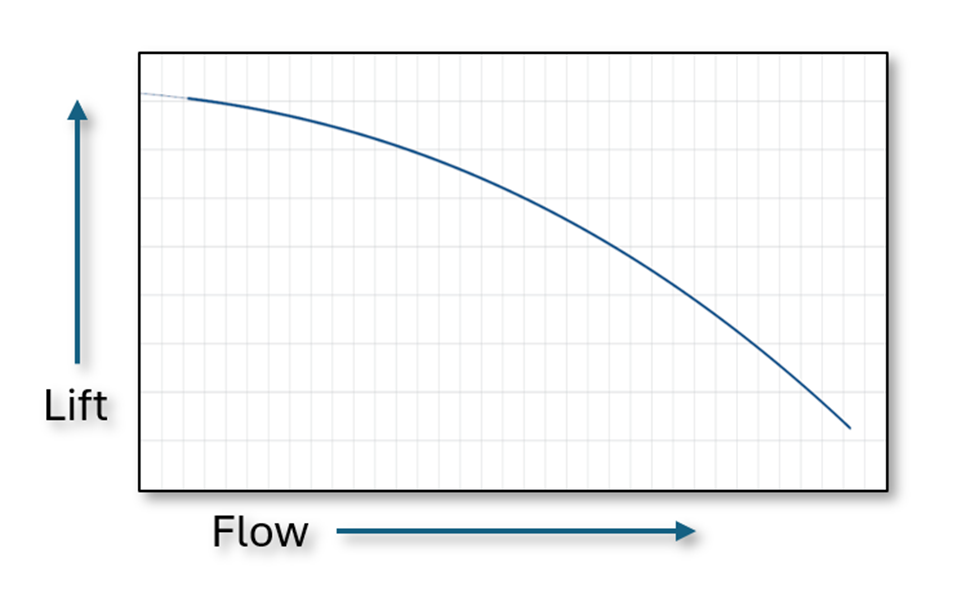
For the purposes of this article, you only need to know that the pump will produce the maximum lift at the lowest flow rate and the lowest lift at the highest flow rate. The exact operating point is always changing as the water demand and TDH fluctuate.
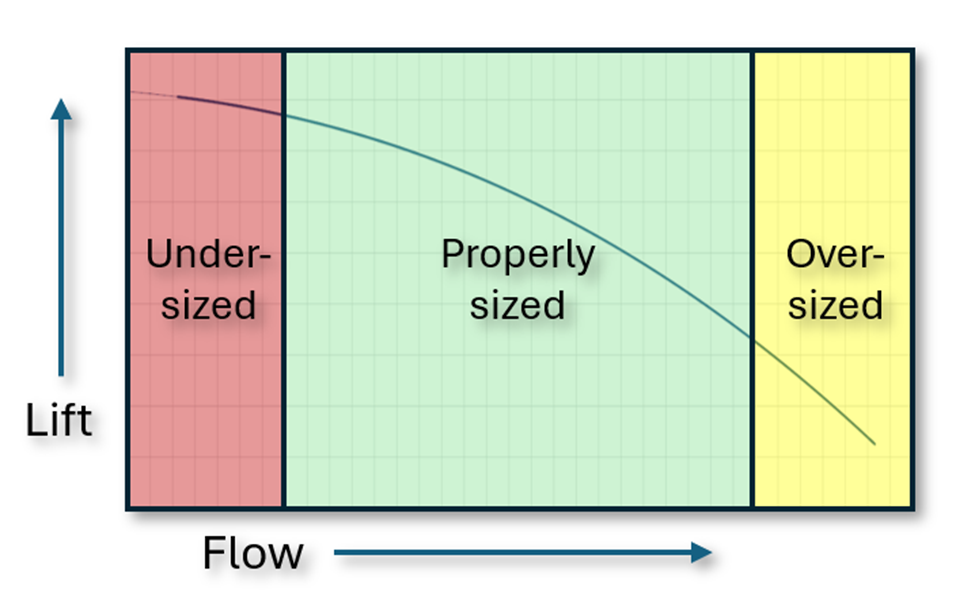
Ideally, the pump should operate in the middle of the pump curve for maximum efficiency. However, an undersized pump will operate with low flow to maximize the lift while an oversized pump will produce high flow well beyond the pump rating. This can be visualized in the graph below:
Detecting Pump Sizing Issues
Since the operating point is always changing, the imbrr Well Monitoring System offers a convenient way to track potential performance concerns. Let’s take a look at a case study of an undersized well pump:
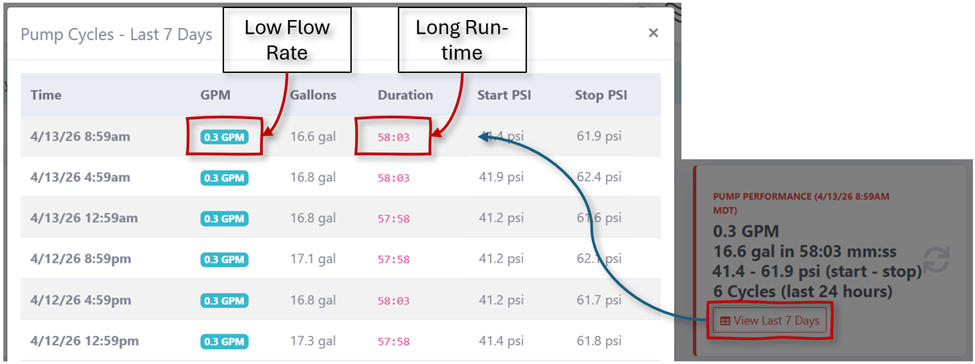
This pump was initially sized to run at ~7 GPM, charging the pressure tank in approximately 2-3 minutes. However, due to the water level dropping 200 ft over time, it’s now running at 0.3 GPM and taking almost an hour to satisfy the pressure switch! This is at extreme risk of deadheading the pump which would likely destroy internal seals, damage the impellor, and melt PVC components/piping from rapid heat buildup. This is an expensive repair.
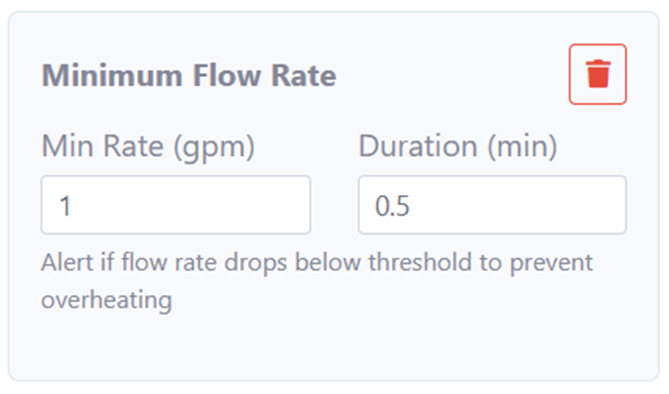
Fortunately, a minimum flow rate alert can be set to proactively detect this dangerous condition (1 GPM is a common threshold to alert of a problem):
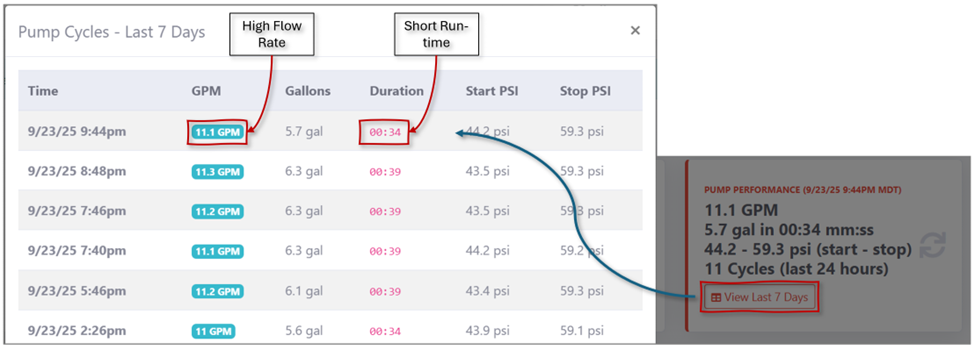
Conversely, an oversized well pump will operate with high flow rate and low runtimes. While it may seem prudent to upsize your pump, oversized well pumps are prone to short cycling, over pumping the well, piping pressure surges, and higher energy costs. This almost always leads to a pump that doesn’t last as long, costs more to run, and can prematurely damage the piping system and/or well. An ON time of less than 1min is a good indication of a potential oversized pump:
Remediation Techniques
While the obvious fix is to correct the pump size, this is an expensive procedure if the pump is still working properly. As such, a list of lower cost techniques can be found below which are often suitable alternatives:
Undersized Pumps
- Maximize well levels and production – see this blog.
- Lower household pressure – see this blog on adjusting the pressure switch.
- Pump into a cistern rather than pressure tank. This will eliminate the discharge pressure thereby lowering the lift requirement.
Oversized Pumps
- Upsize the pressure tank to reduce short cycling and extend the runtime.
- Adjust pressure switch for a wider differential – see this blog.
- Install a VFD controller which will allow you to tune the pump speed.
Hopefully this discussion helps identify potential pump sizing problems while offering some unique ways to address. The imbrr Well Monitoring System makes it easy to spot these conditions, allowing for proactive correction before expensive repairs are needed.
Have feedback on this article or want to discuss your individual results? Please reach out to us at support@imbrr.com. We are happy to provide additional suggestions to solve your unique problem statements.